
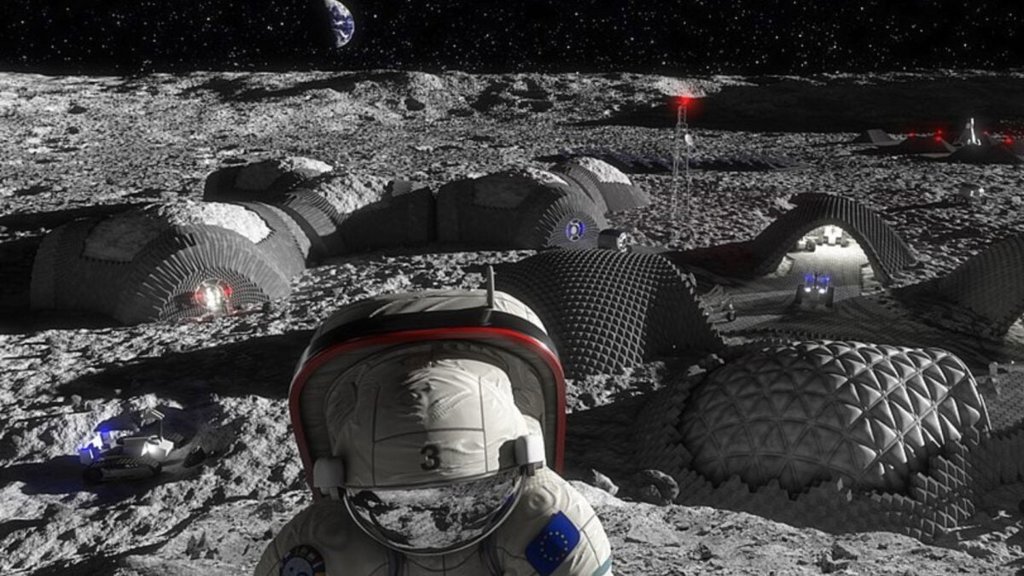
Earlier this year, SpaceX founder and CEO Elon Musk proclaimed his company’s plan to build a “self-growing city” on the Moon in less than 10 years. But turning that vision into reality will depend on whether the Moon can provide enough of the resources humans need to survive. Water, in particular, will be critical. New research, however, suggests that the Moon’s water reserves may be far too limited to sustain a large-scale, long-term human presence. Based on current evidence, scientists estimate there are around 1.3 trillion pounds (600 million metric tons) of water ice hidden in permanently shadowed regions on the Moon. In a recent study published in Frontiers in Space Technologies, a team of researchers found that a city of over 1 million people would exhaust the estimated amount of water on the Moon in a little over two years. The study aims to put ongoing plans to establish a permanent lunar base in perspective by assessing how much the Moon can actually provide to sustain long-term human habitation.
Cold water Shortly after the Moon formed, water-rich asteroids bombarded its surface. Those impacts may have deposited water that eventually became trapped as ice near the Moon’s poles. At the poles, large craters with towering rims block sunlight from reaching inside. Scientists believe the moon’s water supply is hidden within those permanently shadowed regions.
“The presence of water at the lunar poles changes everything about human visits to the Moon,” Martin Elvis, an astronomer at the Smithsonian Astrophysical Observatory and co-author of the study, wrote. “Suddenly it is practical to envisage a ‘Moon village’ where people could survive without importing every last bit from Earth. They could grow their own food and have showers and functional toilets.”
While previous evidence has pointed to there being water on the Moon, we still don’t know exactly how much of it is housed up there. But even the highest possible estimates would not be enough to sustain a self-growing city on the lunar surface, according to the paper.
Lunar thirst For the recent study, the team of scientists used a more generous baseline of 1 billion metric tons while noting that the actual amount of water on the Moon could be 20 to 30 times less. The paper compares the power and water resources of the Moon with the needs of a city with a population of one million people. Even while using the more optimistic estimate, the researchers found that the city would only last a few years before exhausting the entire supply of water on the Moon. The researchers then factored in a strict recycling system, the same one used on the International Space Station. With 98% recycling efficiency, the city would then run out of water in just over a century. Based on the findings of the study, a full-blown city on the Moon may not be feasible, but there’s still room for a smaller habitat designed to deliver scientific discoveries from the lunar surface. For a small Moon village of around 1,000 to 10,000 people, the water supply could last for several centuries, according to the researchers.
There are, however, potential solutions to sustaining a larger city on the Moon, either by improving the efficiency of water recycling, lowering water usage, importing more water from nearby asteroids, or just finding more water, the researchers note. “If the ambitious plans of the space billionaires are to be realized, then finding more water will be the first step,” Elvis wrote.