
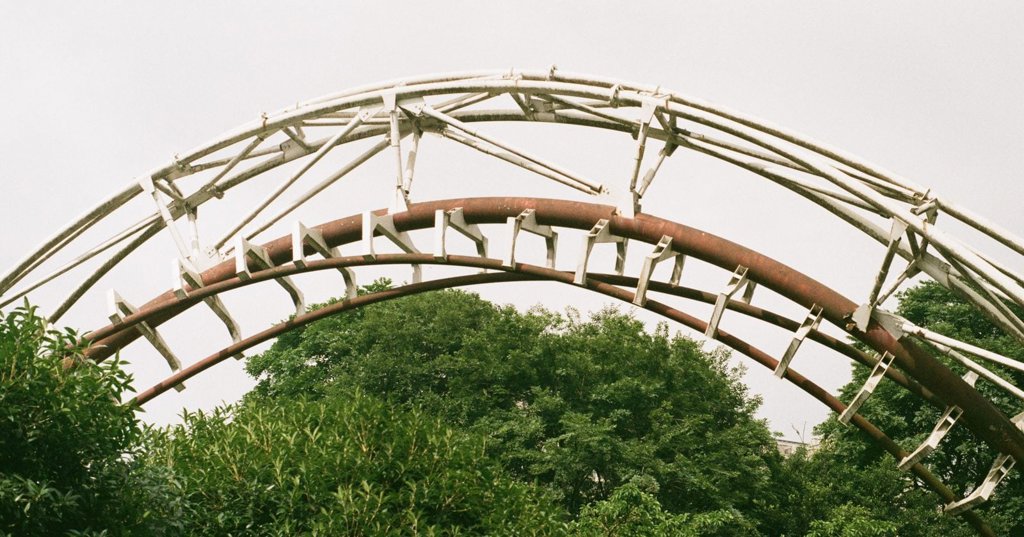
Phones were out, most of them pointed up at the trains cresting the first hill. One of those phones caught something a maintenance walk-through had not: a steel column near the base of the ride, cracked nearly through, flexing each time a loaded train rushed past overhead.
That is roughly what happened at Carowinds, the theme park outside Charlotte, North Carolina, in the summer of 2023.
The visitor was Jeremy Wagner, and the ride was Fury 325. Wagner recalled the moment plainly: “I look up and I see a light come through the pole.” He filmed it. As he told The New York Times, in an account quoted by CBS News, “My hands were shaking because I knew how quick this could be catastrophic.”
What a giga coaster’s steel columns are holding up
To understand why one cracked column mattered so much, it helps to know what the structure carries. Fury 325 is a giga coaster, meaning it has a drop of at least 300 feet. It stands 325 feet tall and reaches speeds up to 95 mph, marketed by Carowinds as the tallest and fastest giga coaster in North America. The trains are not light. Each one carries 32 riders, and the whole ride is a steel structure hundreds of feet in the air.
The support columns keep all that moving weight tracking where it should. When one cracks along a weld line, the load it was carrying has to go somewhere, and the safety margins that keep a ride like this predictable start to shrink. Wagner’s video made that visible to anyone watching: not a hairline flaw requiring instruments to detect, but a beam separated far enough that daylight passed through it, moving as the train went by.
Why a daily walk-through can miss what you can film from the line
The uncomfortable detail is this: the ride was being inspected. The state’s Amusement Device Bureau had run its annual inspection in February 2023 and found only a few signage issues. Regular inspections were happening too, and they had not caught the fracture. State Department of Labor inspectors only arrived afterward, once the video was already circulating.
How does a crack you can photograph from the line slip past the people whose job is to look? Part of the answer is timing and vantage. A scheduled walk-through checks specific points on a route, at set times, from set angles. A crowd of visitors watches the same structure from dozens of positions across an entire day.
North Carolina Labor Commissioner Josh Dobson said the flaw appears to have been developing for a while: “It looks like maybe six to 10 days prior, some pictures had been taken that shows the beginning of the crack, and then by obviously last Friday, the thing was completely severed.” That was his estimate from photos, not a forensic finding. Another guest, Tiffany Collins Newton, had unknowingly photographed the beginnings of it on June 24, days before anyone understood what they were seeing.
Whether the ride was ever genuinely close to a serious incident is harder to pin down. Amusement ride safety analyst Ken Martin told Fox News Digital he had “no doubt in my mind” the coaster came close to a major incident. That is one independent consultant’s assessment, not the result of an official investigation. Our read is that it is a serious opinion worth hearing, not an established finding.
What the six-week shutdown involved
Carowinds shut Fury 325 down the same day the video spread. What followed was not a quick weld and reopen. The manufacturer, Bolliger & Mabillard, found the beam had fractured along a weld line, and the response widened from a single column to the whole structure. Engineers built and installed a new steel column and worked through the track, supports, and foundation.
The inspection then turned up something else. Late in July, the state reported a second weld problem, which the Department of Labor described as something “which could either be a crack or a break.”
Before the ride carried passengers again, the park ran more than 500 full cycles. Fury 325 reopened on August 10, 2023, closed for nearly six weeks in all.
What crowds of phones change about who catches failure first
What we keep coming back to is not that an inspection missed a crack. Inspections check a sample of points, and samples miss things. What stands out is who caught it instead, and how. A structural flaw on one of the biggest coasters in North America was found by a guest with a phone, filming from the line.
That represents a shift in who forms the first line of detection. A maintenance schedule was built around trained staff at set times. It was not built around several thousand cameras pointed at the same steel all day, some of them recording, a few of them noticing. The February inspection and the walk-throughs still ran. They simply were not the layer that raised the alarm this time, and the layer that did exists whether or not anyone planned for it.
None of this makes casual footage a substitute for engineers, and it would be a mistake to read one viral clip as proof the crowd is a better inspector than a certified one. What it does suggest is that structural problems on public rides now play out in front of an audience that can document them in real time, and sometimes that audience sees the thing first.
A personal measure of deep time
See what has changed in the universe since you were born. Begin with one date. Get a personal, sourced journey through everything that kept moving after you arrived.
Six sourced measurements. No predictions. No astrology.