
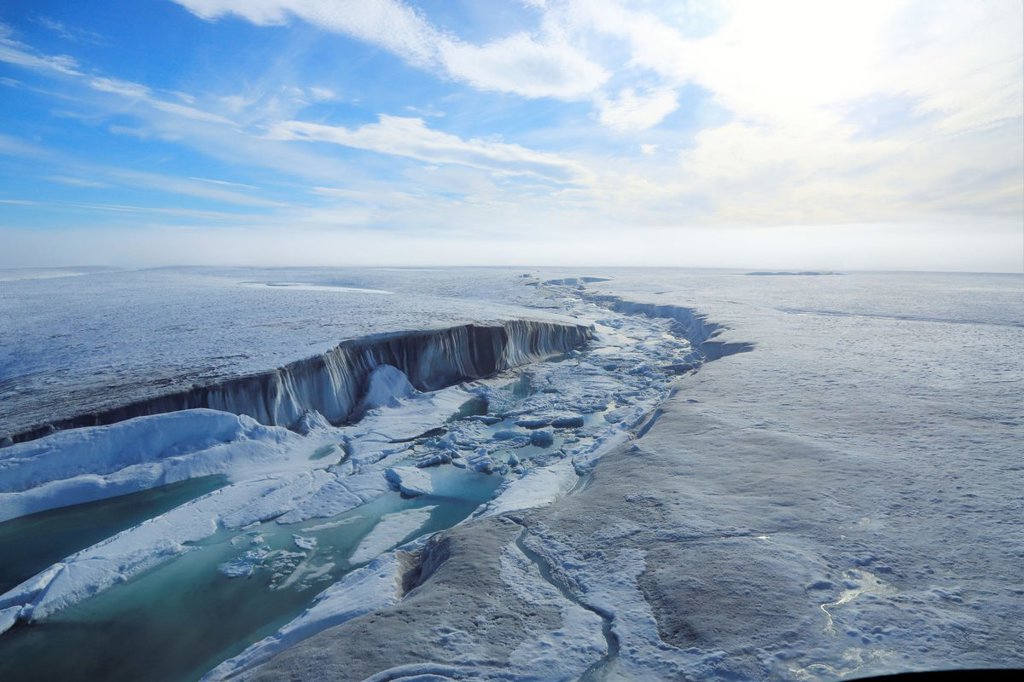
A new study has confirmed what researchers have feared since the breakup of the Milne Ice Shelf in 2020: Canada’s last epishelf lake – a freshwater lake dammed by an ice shelf – has gone.
Drawing on a decade of ocean measurements, satellite images, and field observations collected before and after the breakup, scientists have reconstructed the lake’s disappearance.
Arctic bobtail squid seen alive in natural habitat for first time ever 100km-wide "hidden giant" discovered beneath Antarctic ice sheet
The far north of Canada lies in the Arctic Circle and serves as one of the region’s last refuges for summer sea ice and ice-dependent wildlife, such as polar bears, ringed seals, and Atlantic walruses.
In the local Inuktitut language, these protected areas on northern Ellesmere Island in Nunavut are known as Tuvaijuittuq, ‘the place where ice never melts’.
Only, the ice is melting. The recent loss of the Milne Fiord epishelf lake – a millennia-old ecosystem and the last of its kind in Canada – has demonstrated that even this once seemingly permanent ice refuge is vulnerable to the rapid changes associated with a warming climate.
11 Arctic animals that thrive in this inhospitable freezing landscape Why can't polar bears live in Antarctica?
It may look freezing, but temperatures in the Canadian Arctic are rapidly rising. Credit: Derek Mueller
Why aren't there any penguins in the Arctic?
At the end of August, a study published in Scientific Reports by a team of researchers from the University of British Columbia (UBC), University of Alberta, Université Laval, and Carleton University pulled together many different lines of evidence and demonstrated that the epishelf lake started draining as soon as the Milne Ice Shelf broke apart in July 2020.
By autumn 2020, the epishelf lake and the unique ecosystem it supported had mostly vanished.
“The ice shelf and lake had been thinning for decades, but the 2020 breakup was the last straw. The lake drained within months,” said the study’s lead author Jérémie Bonneau, who conducted part of the research during his PhD at UBC.
An epishelf lake forms when an ice shelf acts as a dam, trapping a layer of freshwater floating above seawater connected to the ocean. These kinds of lakes create multi-story habitats that allow freshwater and marine wildlife to coexist within the same water column.
Where is the coldest place on Earth?
The last ice-dammed lake in Canada has gone, and it’s gone for good, say researchers. Credit: Adrienne White
Scientists resurrect 40,000-year-old organisms from Arctic ice – now they’re worried
The first field measurements collected after the breakup in 2020 showed that, by July 2022, brackish water had fully replaced the lake’s distinct freshwater layer. Since then, annual monitoring has shown no signs of recovery, suggesting the lake has gone for good.
“Epishelf lakes can signal when an ice shelf is under stress, and that’s what we saw here,” said co-author Bernard Laval. “The data showed the ice shelf was failing. Once the ice is gone, the ecosystem goes with it. There’s no coming back.”
Studying dynamic systems such as these in one of the most remote parts of the world is no easy task.
To reach Milne Fiord, researchers had to take multiple flights to Ottawa, Iqaluit, and then Resolute Bay, via Arctic Bay. In Resolute Bay, they spent several days at the federal Polar Continental Shelf Program Base, preparing equipment before a light aircraft, known as a Twin Otter, took them the rest of the way.
Once there, the researchers planted sensor tubes about the size of thermoses, recording temperature, depth and conductivity, which they used to determine the water’s salt content. These instruments were left in place during the COVID-cancelled 2020 field season and weren’t able to be retrieved until two years later.
How the COVID lockdown accidentally created an incredible nature experiment Can any animals survive freezing?
Laval retrieving a mooring in a Milne Ice Shelf pond. Credit: Bella Mouchet
These are the deadliest sinkholes on Earth Here's why polar bears don't freeze in Arctic waters
“We saw the [Milne Ice Shelf] breakup on satellite images, and two years later we got the data,” said Laval. “The instruments were there, observing. We just couldn’t reach them.”
The study found that freshwater entering Milne Fiord is now flushed directly into the ocean as the remaining ice shelf can no longer contain it. For the lake to re-establish itself, the ice shelf would need to recover – something the researchers say is an impossibility given the current climate trajectory.
“These systems took thousands of years to form and were lost in months,” said Bonneau. “On any human timescale, they are not coming back.”
You can read more about the study published in Scientific Reports here.
Top image: As the Milne Ice Shelf fractured, it exposed freshwater channels that once lay protected beneath the surface. Credit: Cameron Fitzpatrick
More stories from around the world
An elephant-like animal was discovered in this gigantic underwater cave. And that’s not all It's one of the oldest and driest deserts in the world, is 5 times drier than the Sahara – and it's about to bloom with millions of flowers People started building artificial beaver dams in California. Now something "mind blowing" is happening It looks like spaghetti, doesn’t have a gut or mouth – and has been feeding on bioplastics for millions of years